


This is default featured post 1 title
Go to Blogger edit html and find these sentences.Now replace these sentences with your own descriptions.

This is default featured post 2 title
Go to Blogger edit html and find these sentences.Now replace these sentences with your own descriptions.

This is default featured post 3 title
Go to Blogger edit html and find these sentences.Now replace these sentences with your own descriptions.

This is default featured post 4 title
Go to Blogger edit html and find these sentences.Now replace these sentences with your own descriptions.

This is default featured post 5 title
Go to Blogger edit html and find these sentences.Now replace these sentences with your own descriptions.
Showing posts with label Download. Show all posts
Showing posts with label Download. Show all posts
Saturday, April 2, 2011
Thursday, December 4, 2008
Professional SQL Server 2000 Database Design
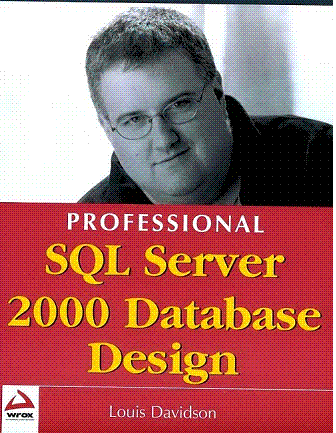
About the Author
Louis is an avowed database nut. Currently he is toiling as the database architect for Education Networks
of America in Nashville, Tennessee, not to mention writing this book and hopefully one more. Microsoft Windows XP Registry Guide

Chapter 1: Learning the Basics
Overview
The registry has a subtle but important role in Microsoft Windows XP. On one hand, the registry is
passive—it's just a big collection of settings sitting on your hard disk, and you probably don't think
much about it while you're editing a document, browsing the Internet, or searching for a file. On the
other hand, it plays a key role in all those activities. The settings in the registry determine how
Windows XP appears and how it behaves. They even control applications running on your
computer. This gives the registry great potential as a tool for power users or IT professionals,
enabling them to customize settings that aren't available in the user interface.
This chapter introduces the registry to you. First you learn about the registry's role and how it fits
into your world. Then I explain some important terminology to ensure that we're speaking the same
language, and you see how Windows XP organizes the registry. Next you learn about the tools I
use to edit the registry. And last, you see how Windows XP stores the registry on the hard disk.
Throughout this chapter, you'll find several tidbits that are useful beyond the registry. For example,
you learn about the two different architectures for storing numbers in memory, which IT
professionals run into as much outside the registry as inside.
This is all basic information, but don't skip this chapter. Read it once, and you'll be set for the rest of
this book
Overview
The registry has a subtle but important role in Microsoft Windows XP. On one hand, the registry is
passive—it's just a big collection of settings sitting on your hard disk, and you probably don't think
much about it while you're editing a document, browsing the Internet, or searching for a file. On the
other hand, it plays a key role in all those activities. The settings in the registry determine how
Windows XP appears and how it behaves. They even control applications running on your
computer. This gives the registry great potential as a tool for power users or IT professionals,
enabling them to customize settings that aren't available in the user interface.
This chapter introduces the registry to you. First you learn about the registry's role and how it fits
into your world. Then I explain some important terminology to ensure that we're speaking the same
language, and you see how Windows XP organizes the registry. Next you learn about the tools I
use to edit the registry. And last, you see how Windows XP stores the registry on the hard disk.
Throughout this chapter, you'll find several tidbits that are useful beyond the registry. For example,
you learn about the two different architectures for storing numbers in memory, which IT
professionals run into as much outside the registry as inside.
This is all basic information, but don't skip this chapter. Read it once, and you'll be set for the rest of
this book
Maya Professional Tips and Techniques

Maya
®
Professional Tips
and Techniques.
®
Professional Tips
and Techniques.
Acknowledgments
My thanks go to the excellent editorial and production staff at Wiley, including my
acquisitions editor, Mariann Barsolo; my production editor, Martine Dardignac; and
my technical editor, Keith Reicher.
Special thanks to this book’s special contributors: Michael Stolworthy, Matt Orlich,
James Chandler, Kirk Buckendorf, Rocky Bright Jr., Joshua Perez, and Tim Kelly.
Special thanks to all the animators who have toiled before me and along with me.
3D animation is a wonderful, inspiring medium, particularly when so many pour their
passion into the work.My thanks go to the excellent editorial and production staff at Wiley, including my
acquisitions editor, Mariann Barsolo; my production editor, Martine Dardignac; and
my technical editor, Keith Reicher.
Special thanks to this book’s special contributors: Michael Stolworthy, Matt Orlich,
James Chandler, Kirk Buckendorf, Rocky Bright Jr., Joshua Perez, and Tim Kelly.
Special thanks to all the animators who have toiled before me and along with me.
3D animation is a wonderful, inspiring medium, particularly when so many pour their
Special thanks to my family and friends who supported my wild ambitions. And
the biggest thanks go to my beautiful wife, Anita, who encouraged me all the way
despite all those late, late 3D nights.
I’d like to point out that several of the photos in this book were provided by the
photographers of Stock Xchng (www.sxc.hu). This is a wonderful site that provides
royalty-free, restriction-free material simply out of love of the medium. Additional
models were purchased from Turbo Squid (www.turbosquid.com), another excellent
service.
Customization and
MEL Scripting
MAYA TAKES THE lion’s share of high-end 3D work in
the feature film and visual effects industry. You can
trace this fact to one particular trait: the software
is infinitely customizable. The customization is not
restricted to multimillion-dollar productions, however.
You can customize Maya to your own tastes and
thereby work faster, more intelligently, and most
important, more comfortably. The most thorough and
powerful method of customization is the application
of MEL scripting. MEL is the underlying language on
which the entire program is built. Every single tool
and function within Maya has one or more lines of
MEL code associated with it
MEL Scripting
MAYA TAKES THE lion’s share of high-end 3D work in
the feature film and visual effects industry. You can
trace this fact to one particular trait: the software
is infinitely customizable. The customization is not
restricted to multimillion-dollar productions, however.
You can customize Maya to your own tastes and
thereby work faster, more intelligently, and most
important, more comfortably. The most thorough and
powerful method of customization is the application
of MEL scripting. MEL is the underlying language on
which the entire program is built. Every single tool
and function within Maya has one or more lines of
MEL code associated with it
Thursday, November 20, 2008
Practical Web 2.0 Applications with PHP

Practical Web 2.0
Applications with PHP
Practical Web 2.0 Applications with PHP
Copyright © 2008 by Quentin Zervaas
All rights reserved. No part of this work may be reproduced or transmitted in any form or by any means,
electronic or mechanical, including photocopying, recording, or by any information storage or retrieval
system, without the prior written permission of the copyright owner and the publisher.
ISBN-13 (pbk): 978-1-59059-906-8
ISBN-10 (pbk): 1-59059-906-3
ISBN-13 (electronic): 978-1-4302-0474-9
ISBN-10 (electronic): 1-4302-0474-5
Printed and bound in the United States of America 9 8 7 6 5 4 3 2 1
Trademarked names may appear in this book. Rather than use a trademark symbol with every occurrence
of a trademarked name, we use the names only in an editorial fashion and to the benefit of the trademark
owner, with no intention of infringement of the trademark.
Lead Editor: Ben Renow-Clarke
Technical Reviewer: Jeff Sambells
Editorial Board: Steve Anglin, Ewan Buckingham, Tony Campbell, Gary Cornell, Jonathan Gennick,
Jason Gilmore, Kevin Goff, Jonathan Hassell, Matthew Moodie, Joseph Ottinger, Jeffrey Pepper,
Ben Renow-Clarke, Dominic Shakeshaft, Matt Wade, Tom Welsh
Project Manager: Richard Dal Porto
Copy Editors: Andy Carroll, Kim Wimpsett
Assistant Production Director: Kari Brooks-Copony
Production Editor: Liz Berry
Compositor: Diana Van Winkle
Proofreader: Lisa Hamilton
Indexer: Broccoli Information Management
Artist: Diana Van Winkle
Cover Designer: Kurt Krames
Manufacturing Director: Tom Debolski
Distributed to the book trade worldwide by Springer-Verlag New York, Inc., 233 Spring Street, 6th Floor,
New York, NY 10013. Phone 1-800-SPRINGER, fax 201-348-4505, e-mail orders-ny@springer-sbm.com, or
visit http://www.springeronline.com.
For information on translations, please contact Apress directly at 2855 Telegraph Avenue, Suite 600,
Berkeley, CA 94705. Phone 510-549-5930, fax 510-549-5939, e-mail info@apress.com, or visit
http://www.apress.com.
The information in this book is distributed on an “as is” basis, without warranty. Although every precaution
has been taken in the preparation of this work, neither the author(s) nor Apress shall have any liability to any
person or entity with respect to any loss or damage caused or alleged to be caused directly or indirectly by
the information contained in this work.
The source code for this book is available to readers at http://www.apress.com.
Download Link


Tuesday, November 18, 2008
User Guide and Tutorial

cPanel: User Guide and Tutorial
Get the most from cPanel with this easy-to-follow guide
Copyright © 2006 Packt Publishing
All rights reserved. No part of this book may be reproduced, stored in a retrieval system, or
transmitted in any form or by any means, without the prior written permission of the publisher,
except in the case of brief quotations embedded in critical articles or reviews.
Every effort has been made in the preparation of this book to ensure the accuracy of the
information presented. However, the information contained in this book is sold without warranty,
either express or implied. Neither the author, Packt Publishing, nor its dealers or distributors will
be held liable for any damages caused or alleged to be caused directly or indirectly by this book.
Packt Publishing has endeavored to provide trademark information about all the companies and
products mentioned in this book by the appropriate use of capitals. However, Packt Publishing
cannot guarantee the accuracy of this information.
First published: March 2006
Production Reference: 1030306
Published by Packt Publishing Ltd.
32 Lincoln Road
Olton
Birmingham, B27 6PA, UK.
ISBN 1-904811-92-2
www.packtpub.com
Cover Design by www.visionwt.com
Download Link
Mastering JavaServer

JavaServer
™
Faces
Bill Dudney
Jonathan Lehr
Bill Willis
LeRoy Mattingly
Wiley Publishing, Inc.
Vice President and Executive Group Publisher: Richard Swadley
Vice President and Executive Publisher: Robert Ipsen
Vice President and Publisher: Joseph B. Wikert
Executive Editorial Director: Mary Bednarek
Editorial Manager: Kathryn A. Malm
Executive Editor: Robert Elliott
Managing Production Editor: Fred Bernardi
Development Editor: Eileen Bien Calabro, Sharon Nash
Production Editor: Felicia Robinson
Media Development Specialist: Greg Stafford
Text Design & Composition:Wiley Composition Services
Copyright 2004 by Wiley Publishing Inc., Indianapolis, Indiana.
All rights reserved.
Published by Wiley Publishing, Inc., Indianapolis, Indiana
Published simultaneously in Canada
No part of this publication may be reproduced, stored in a retrieval system, or transmitted
in any form or by any means, electronic, mechanical, photocopying, recording, scanning, or
otherwise, except as permitted under Section 107 or 108 of the 1976 United States Copyright
Act, without either the prior written permission of the Publisher, or authorization through
payment of the appropriate per-copy fee to the Copyright Clearance Center, Inc., 222 Rose-
wood Drive, Danvers, MA 01923, (978) 750-8400, fax (978) 646-8600. Requests to the Pub-
lisher for permission should be addressed to the Legal Department, Wiley Publishing, Inc.,
10475 Crosspoint Blvd., Indianapolis, IN 46256, (317) 572-3447, fax (317) 572-4355, E-mail:
brandreview@wiley.com.
Download Link
Beginning Programming with Java™ For Dummies®, 2nd Edition

eginning Programming with Java™ For Dummies®, 2nd Edition
Published by
Wiley Publishing, Inc.
111 River Street
Hoboken, NJ 07030-5774
www.wiley.com
Copyright © 2005 by Wiley Publishing, Inc., Indianapolis, Indiana
Published by Wiley Publishing, Inc., Indianapolis, Indiana
Published simultaneously in Canada
No part of this publication may be reproduced, stored in a retrieval system or transmitted in any form or by
any means, electronic, mechanical, photocopying, recording, scanning or otherwise, except as permitted
under Sections 107 or 108 of the 1976 United States Copyright Act, without either the prior written permis-
sion of the Publisher, or authorization through payment of the appropriate per-copy fee to the Copyright
Clearance Center, 222 Rosewood Drive, Danvers, MA 01923, (978) 750-8400, fax (978) 646-8600. Requests to
the Publisher for permission should be addressed to the Legal Department, Wiley Publishing, Inc., 10475
Crosspoint Blvd., Indianapolis, IN 46256, (317) 572-3447, fax (317) 572-4355, or online at http://www.
wiley.com/go/permissions.
Trademarks: Wiley, the Wiley Publishing logo, For Dummies, the Dummies Man logo, A Reference for the
Rest of Us!, The Dummies Way, Dummies Daily, The Fun and Easy Way, Dummies.com, and related trade
dress are trademarks or registered trademarks of John Wiley & Sons, Inc., and/or its affiliates in the United
States and other countries, and may not be used without written permission. Java is a trademark of Sun
Microsystems, Inc. All other trademarks are the property of their respective owners. Wiley Publishing, Inc.,
is not associated with any product or vendor mentioned in this book
Download Link
XML Schema Essentials

Publisher: Robert Ipsen
Editor: Cary Sullivan
Developmental Editor: Scott Amerman
Associate Managing Editor: Penny Linskey
Associate New Media Editor: Brian Snapp
Text Design & Composition: D&G Limited, LLC
Designations used by companies to distinguish their products are often claimed as
trademarks. In all instances where John Wiley & Sons, Inc., is aware of a claim, the product
names appear in initial capital or ALL CAPITAL LETTERS. Readers, however, should contact
the appropriate companies for more complete information regarding trademarks and
registration.
This book is printed on acid-free paper.
Copyright © 2002 by R. Allen Wyke and Andrew Watt. All rights reserved.
Published by John Wiley & Sons, Inc.
Published simultaneously in Canada.No part of this publication may be reproduced, stored in a retrieval system or transmitted
in any form or by any means, electronic, mechanical, photocopying, recording, scanning or
otherwise, except as permitted under Sections 107 or 108 of the 1976 United States Copy-
right Act, without either the prior written permission of the Publisher, or authorization
through payment of the appropriate per-copy fee to the Copyright Clearance Center, 222
Rosewood Drive, Danvers, MA 01923, (978) 750-8400, fax (978) 750-4744. Requests to the
Publisher for permission should be addressed to the Permissions Department, John Wiley
& Sons, Inc., 605 Third Avenue, New York, NY 10158-0012, (212) 850-6011, fax (212) 850-
6008, E-Mail: PERMREQ @ WILEY.COM.
Download Link


